In the highlands of South Sulawesi, Indonesia, the Toraja people live among the dead in the most literal sense. A grandmother who died last spring may still be at home in the back room, washed, dressed and spoken to each morning, because her family has not yet held her funeral, and until they do she is not considered dead at all. Visitors arrive expecting something macabre and leave with something closer to tenderness.
This guide takes the Happy Living film on living with the dead in Toraja and adds the context a traveler needs: what the beliefs mean, how the funerals work, where the cliff graves are, how to reach this remote corner of Indonesia, and how to be a respectful guest.
Watch the Film First
The film spends its time in the villages around Rantepao. It visits a family caring for a relative who has been at home for more than a year, follows a Rambu Solo funeral from the arrival of guests to the sacrifice of the buffalo, climbs to the tau tau balconies at the cliff graves of Lemo, and sits with villagers who explain why none of this feels strange to them. The question it keeps returning to is a simple one: what changes about grief when death is allowed to take its time?
Death as a Slow Journey, Not a Single Moment
The key to understanding Toraja is that death here is a process rather than an event. When a person stops breathing, the family does not say they have died. They say they are to makula', a sick person. The body is treated with formalin, where once it was preserved with herbs and kitchen smoke, and laid in a room of the family tongkonan, the ancestral house. Relatives bring food to the bedside, talk to the person, and include them in the life of the house. This can last months; for families saving for a large ceremony it can last years. Only when the funeral has been held does the soul begin its journey to Puya, the land of souls, and only then is the word for dead used.
That funeral is Rambu Solo, and it is the center of Toraja social life. Ceremonies run for days and draw hundreds or even thousands of guests. A ceremonial field, the rante, is ringed with temporary bamboo pavilions called lantang, built for the visiting family groups. There are processions, the slow circle dance of the ma'badong in which mourners link fingers and chant the life story of the deceased, buffalo fights, and the distribution of meat according to a social accounting that everyone present understands. At the heart of it all is the sacrifice of water buffalo and pigs. The Toraja believe the buffalo carry the soul to Puya and that the number and quality of the animals shape how the deceased arrives there. A single tedong bonga, the rare spotted buffalo with pale pink skin and black patches, can sell for tens of thousands of dollars, and the largest noble funerals may slaughter dozens of animals. Families go into debt for this, with relatives working in Jakarta or abroad sending money home for years. The cost is the reason the dead wait at home so long, and it is also, in Toraja eyes, the measure of love.
Underneath the ceremony sits Aluk To Dolo, the way of the ancestors, the animist belief system that ordered Toraja life before Dutch missionaries arrived in the early 1900s. Most Toraja today are Protestant or Catholic, with a Muslim minority, and a church service is as much a part of a modern funeral as the buffalo. The two systems have not so much competed as layered: Christianity handles where the soul goes, and the old rituals handle how the living say goodbye. The Indonesian government classifies Aluk To Dolo as a branch of Hinduism for administrative purposes, which is why these older rites are legally recognized. If you have read our guide to Day of the Dead in Mexico, the pattern will feel familiar: an indigenous relationship with the dead that absorbed a new religion without surrendering its heart.
Cliff Graves, Tau Tau and the Day the Dead Walk Again
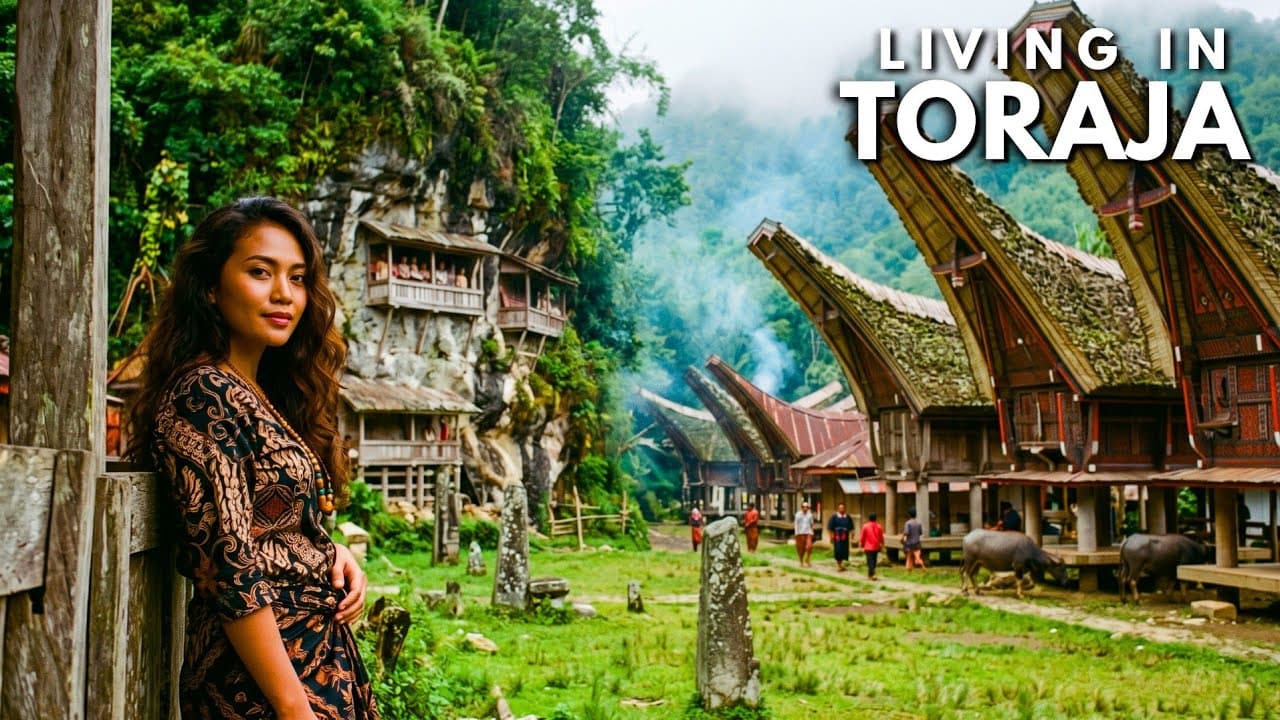
Toraja does not bury its dead in the ground. Soil is for rice, and rice is life. Instead, coffins go into chambers cut high into limestone cliffs, into natural caves, or into hanging graves suspended from the rock on wooden beams. At Lemo, about 12 kilometers south of Rantepao, rows of square doors are cut into a sheer cliff face, and above them stand balconies of tau tau, wooden effigies carved to resemble the dead, arms outstretched with palms upward. At Londa, a cave is stacked with coffins, some centuries old, with skulls arranged on ledges and tau tau gazing out from the entrance. Ke'te' Kesu', the best-preserved traditional village, has hanging graves behind its houses. Near Sangalla', the Kambira baby grave is a living tarra tree whose trunk holds the tiny chambers of infants who died before their teeth came in; the family sealed the child inside with palm fiber so the tree would grow around them and its sap would feed them as milk once did.
Then there is Ma'Nene, the ritual behind most of the headlines. Every few years, usually in August after the rice harvest, families in the northern villages around Pangala' and Baruppu' open the family tombs and bring their relatives out. The bodies, many of them mummified by formalin and the dry highland air, are cleaned, brushed and dressed in new clothes. Broken coffins are repaired. Some families walk the deceased around the village or stand them up for a photograph that spans the living and the dead. It can look shocking in a thumbnail. In person it is a family reunion, often with laughter, and its purpose is simple: care for the ancestors so that they continue to care for the living and the harvest.
All of this takes place in the shadow of the tongkonan, the boat-shaped ancestral houses that are the most recognizable image of Toraja. Their sweeping roofs, said to echo the prows of ancestral boats, rise over carved facades painted red, black, white and yellow. On the front pole hang stacks of buffalo horns, one for each animal sacrificed at a funeral held by that house, and the taller the stack, the higher the standing of the family. Facing each tongkonan is a row of alang, rice barns on smooth pillars that rats cannot climb. House, barn, graves and funeral are not separate things in Toraja. They are one system that binds a family to its land and its dead.
What It's Really Like to Visit
Toraja is remote, inexpensive once you arrive, and far more welcoming than its reputation suggests. Plan for slowness.
- Best time to go: The main funeral season runs from June to September, after the rice harvest, when families scattered across Indonesia come home. In this window there is a good chance of a Rambu Solo somewhere near Rantepao in any given week. Ma'Nene usually happens in August in the Pangala' area, but each village sets its own dates and rarely announces them far ahead.
- Getting there: Fly to Makassar, the main gateway to Sulawesi. From there it is roughly 8 to 10 hours by bus or hired car on a winding road north to Rantepao; overnight buses with reclining seats are the standard option. Small aircraft also fly to Toraja Airport near Makale a few times a week, though schedules change often and bookings are easiest to make locally.
- Where to base: Rantepao, in Toraja Utara, is the practical hub, with guesthouses, guides, motorbike rental and a lively market. Lemo, Londa, Ke'te' Kesu' and the villages around Pangala' are all within about an hour by road. Makale, the capital of Tana Toraja, is quieter and closer to the airport.
- Costs: A clean guesthouse room is roughly 10 to 25 US dollars a night, a meal in Rantepao a few dollars, and a rented motorbike about 7 to 10 dollars a day. Entry fees are small; the main expense is a guide and driver.
- Hiring a local guide: Worth it, and for funerals essential. A Toraja guide will know which families are holding ceremonies that week, can make the introduction, and will explain who is who on the ceremonial field. Expect roughly 30 to 50 US dollars a day plus transport; your guesthouse can arrange one.
- Funeral etiquette and gifts: You are a guest at a family event, not a spectator at a show. Go with a guide, ask the family's permission, and bring a gift: a carton of cigarettes or a kilo or two of sugar is customary and will be formally recorded. Dress modestly in dark colours. Sit where you are placed, accept the coffee offered, and never walk across the rante during a procession. The sacrifices are bloody and real; if you cannot watch, step away quietly.
- Photography consent: Ask before photographing people, above all the family of the deceased and the bodies during Ma'Nene. Most families will say yes, but the asking matters. Leave the drone in the bag unless the family has explicitly agreed.
- Weather: The highlands sit at roughly 700 to 1,000 meters, so days are warm and nights pleasantly cool. The dry season runs from about May to October, but afternoon rain is possible in any month, and the November to April wet season can wash out roads.
- Health: Malaria risk is low in the highlands but present in the lowlands of Sulawesi; use repellent, check current advice, and take dengue seriously year round. Serious medical care means a return to Makassar, so carry travel insurance with evacuation cover and a basic first aid kit.
For another culture that folds death into its calendar, read our guide to Samhain and the origins of Halloween in Ireland, where the dead are honoured with fire rather than buffalo.
What to Pack for Toraja
Pack for a rainy highland region of cliff paths, bamboo floors and long bus rides.
Affiliate picks, not a shopping checklist. Use what you own first. Check the listing's model, size, seller and current availability before purchasing.
Lonely Planet Indonesia Travel Guide
The most complete guide to Sulawesi and the Toraja highlands, with transport details for the long road from Makassar. Check for the latest edition.

Lowepro Flipside Trek Camera Backpack
Toraja cliff graves and ceremonies demand a good camera, protect it. The rear-access design keeps your gear dry and secure on crowded ceremonial fields and muddy paths.
Quick-Dry Travel Towel
Guesthouses in Rantepao do not always provide towels, and nothing dries fast in highland humidity. A microfiber towel packs small and is ready again by morning.

Osprey Farpoint 40
Sulawesi is remote, travel light with one bag. A carry-on pack that fits in a bus luggage rack and on the back of a motorbike makes the trip from Makassar far easier.
FAQ
Can tourists attend a Toraja funeral?
Yes. Rambu Solo ceremonies are public community events, and Toraja families have hosted outside guests for decades. The accepted approach is to go with a local guide who knows the family, bring a gift such as cigarettes or sugar, dress modestly, and sit where you are placed. The family will usually record your gift and your name, and in return you will be offered coffee and food. Turning up without an introduction or treating the event as a photo opportunity is poor form.
Why do the Toraja keep dead relatives at home?
Because in Toraja belief a person is not dead until the funeral has been held, and funerals are expensive. The body is preserved with formalin and kept in the family house as a sick person while relatives save money and gather buffalo. This can take months or several years, and throughout that time the deceased remains part of the household.
Is Ma'Nene held every year?
No. Each family and village holds Ma'Nene on its own cycle, often every few years, and usually in August after the harvest. It is concentrated around Pangala' and Baruppu' in Toraja Utara. If seeing it is a priority, contact a Rantepao guide a few weeks before your trip, because villages decide late and the exact day is rarely published.
Watch More from Happy Living
Toraja is one stop on a longer journey through places where the living and the dead share the same ground. Browse the full Happy Living film collection for Day of the Dead in Mexico, the Samhain fires of Ireland and the autumn temples of Kyoto, or subscribe on YouTube to catch each new film the week it is released. The journal has a companion guide for every destination.